Design drill guides for flat or curved surfaces in minutes

Applications for custom drill guides
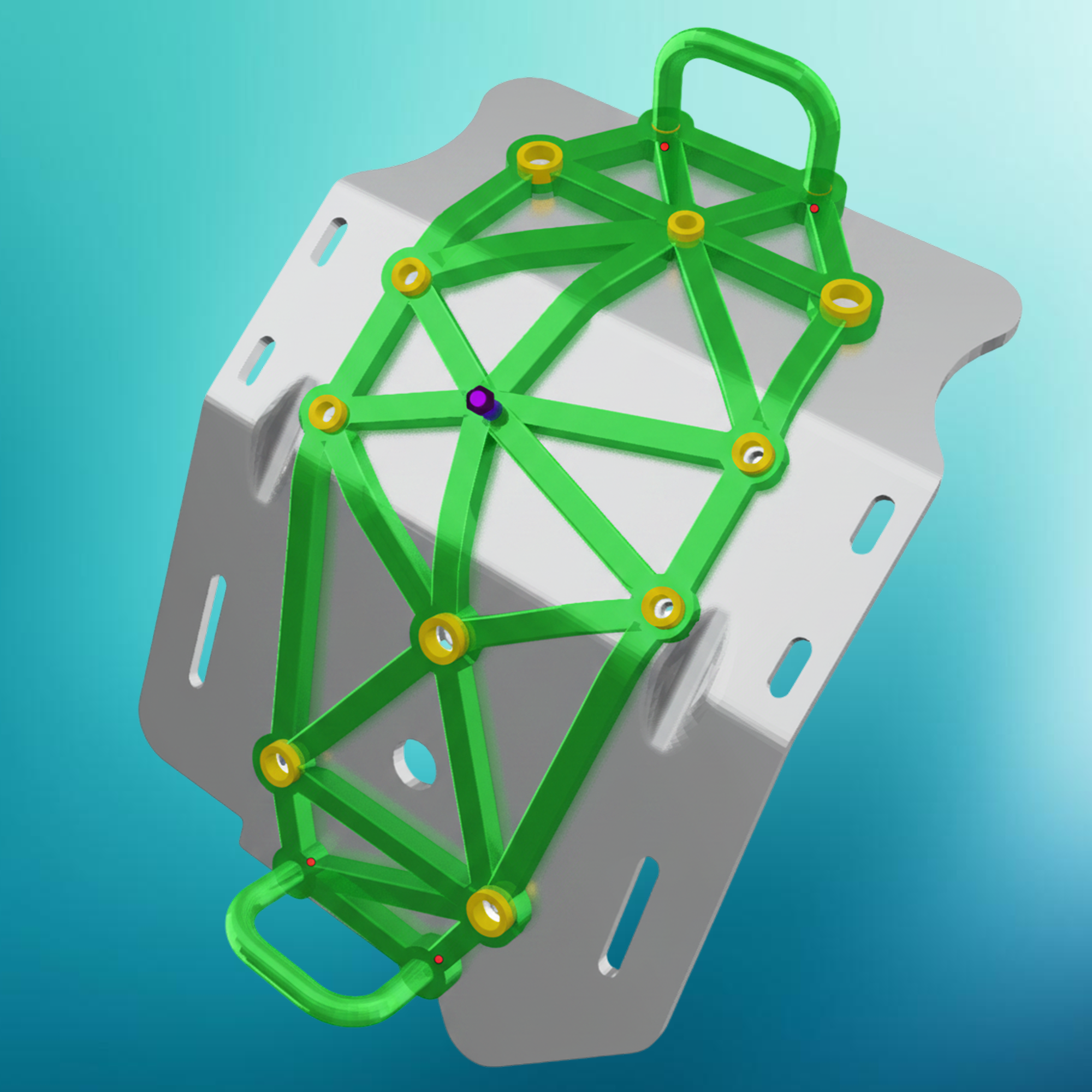
Custom drill guides are used across a wide range of manufacturing and maintenance applications where accurate hole positioning is critical.

In aerospace manufacturing and MRO workflows, drill guides help technicians create precise hole patterns on curved fuselage sections, structural brackets, and composite components while maintaining repeatability during assembly and repair operations.

Automotive manufacturers use drill guides for repeat drilling tasks during fixture assembly, prototype development, and production line modifications where fast and accurate positioning is required.

Industrial equipment manufacturers often use custom drilling templates for hydraulic systems, welded assemblies, valve blocks, and machined housings with complex geometries.

Drill guides are also widely used in maintenance and field-service operations where portable, lightweight tooling helps operators reproduce accurate hole locations directly on site.

Because additive manufacturing allows highly customized geometries, 3D printed drill guides are particularly useful for low-volume production, high-mix manufacturing, and applications involving irregular or curved surfaces.

Drill Guide

Why manufacturers use 3D printed drill guides

Traditional drill fixtures can be expensive and time-consuming to manufacture, especially for low-volume production or frequently changing part designs.

Additive manufacturing makes it possible to create custom drill guides much faster while reducing tooling costs and simplifying iteration.

Because 3D printing allows lightweight and highly customized geometries, drill guides can be optimized for operator handling, material efficiency, and part-specific alignment features.

Manufacturers also benefit from shorter lead times compared to conventional machined tooling. Custom guides can often be produced directly on site, helping production teams respond quickly to engineering changes or urgent repair requirements.

3D printed drill guides are especially valuable for:

  • Curved or irregular surfaces

  • Prototype and low-volume production

  • Aerospace repair workflows

  • Complex hole patterns

  • Portable field-service tooling

  • Rapid iteration during product development

By combining additive manufacturing with automated design workflows, manufacturers can create accurate, production-ready drilling solutions with significantly less manual effort.

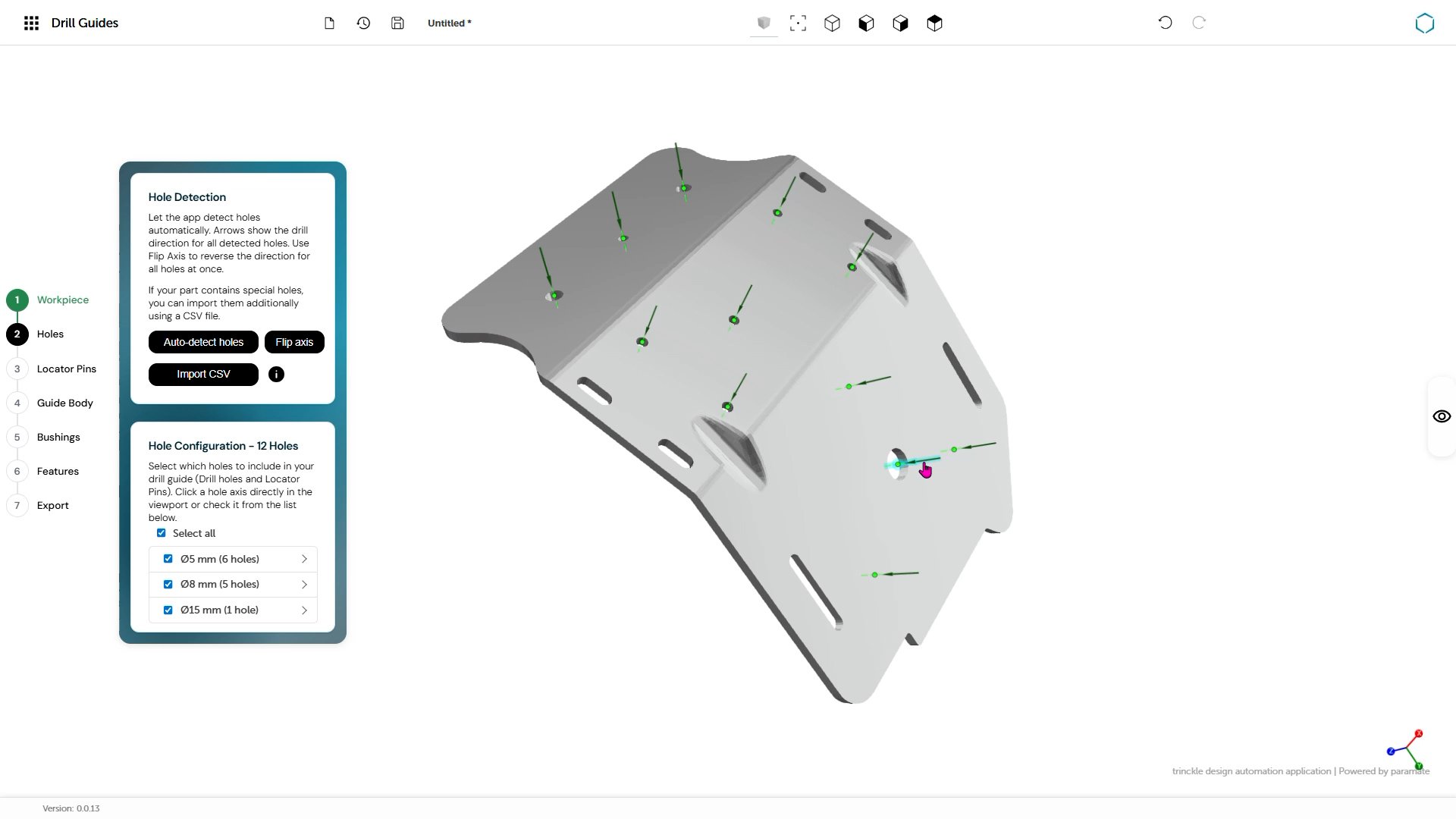
hole auto detection

Design automation for drill guides

Design automation simplifies this process by turning repetitive manual steps into guided workflows.

Instead of manually building drill guides from scratch, automated workflows can detect holes directly from CAD geometry, generate guide bodies automatically, and prepare designs for 3D printing in minutes.

This makes custom tooling far more accessible to production teams without requiring advanced CAD skills.

It also becomes easier to iterate quickly when parts change or new drilling requirements appear.

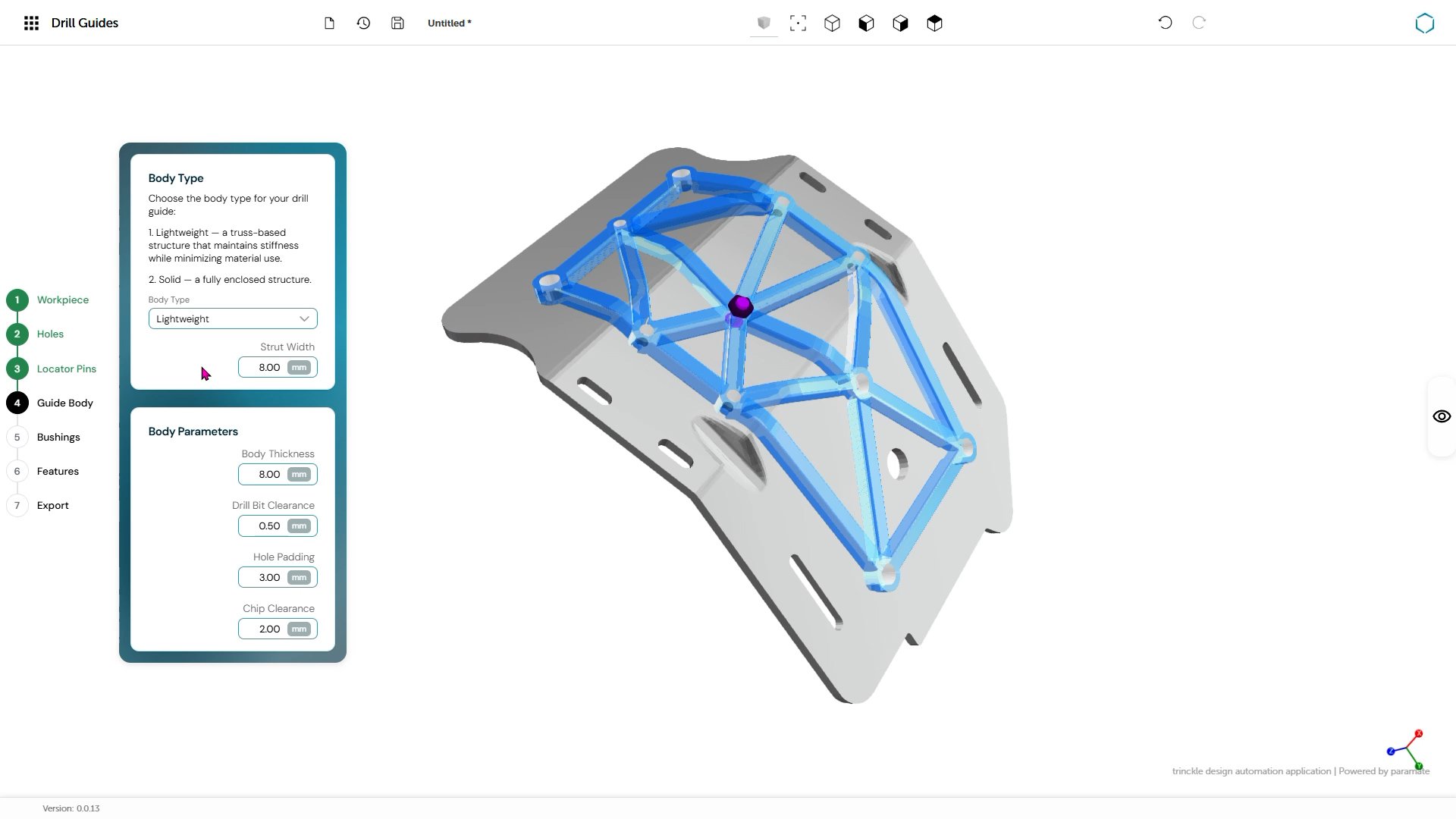
lightweight guide body

How the Additive App Suite helps you design drill guides

The Drill Guides app in the Additive App Suite automates many of the most time-consuming parts of drill guide creation.

The app can automatically detect cylindrical holes from a CAD file with a single click, removing a large amount of manual setup work. For more complex workflows, CSV import also allows users to define exactly which holes should be included.

Once hole positions are defined, the app automatically generates lightweight, custom, 3D print-ready drill guides for accurate and consistent hole placement on flat or curved surfaces.

The guides are optimized for additive manufacturing, reducing print time and material usage while maintaining the strength needed for real shop-floor use.

The app also supports industrial-standard locator pins and bushing seats, allowing manufacturers to combine 3D-printed tooling with proven hardware components for reliable positioning and durability.

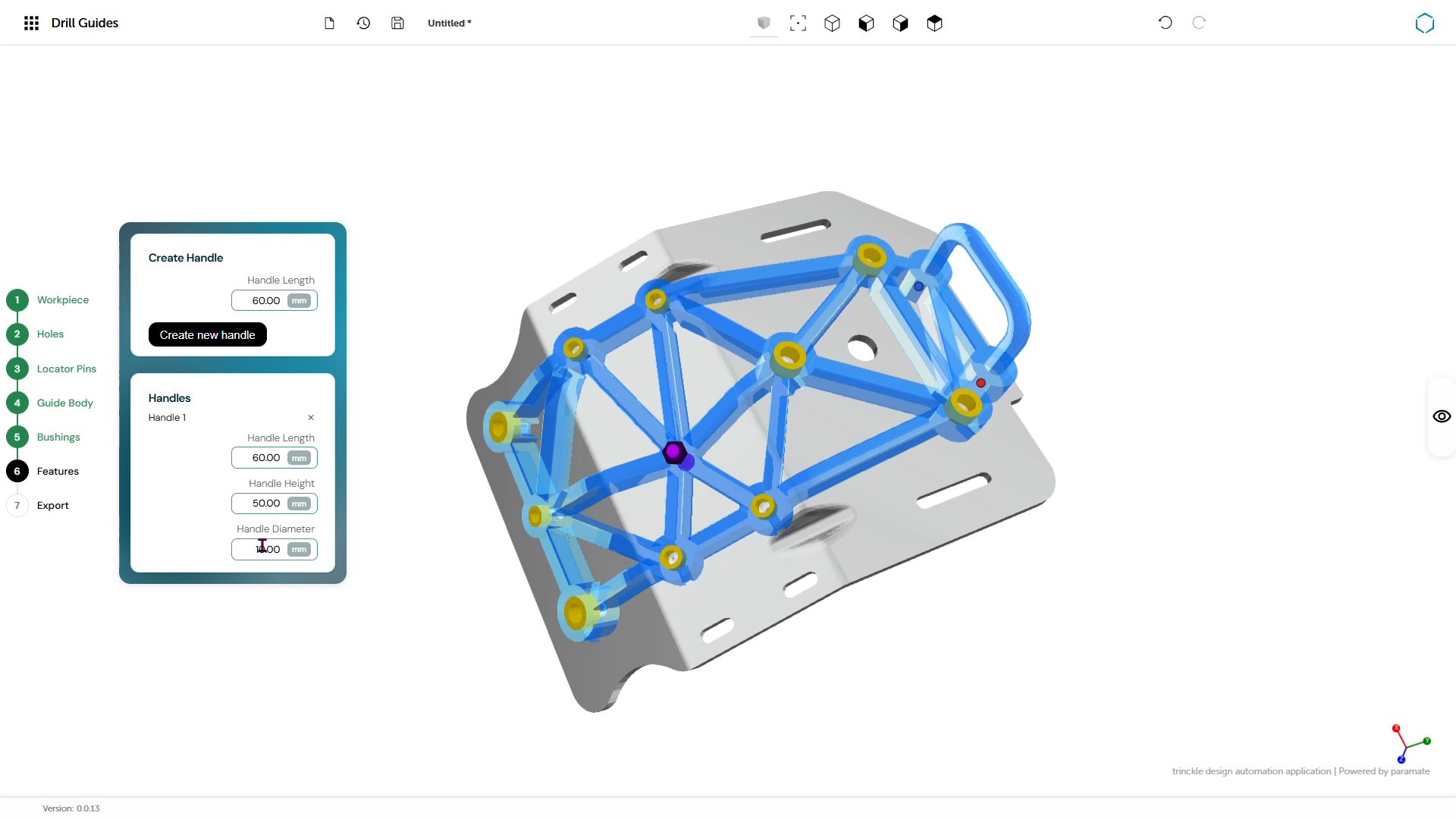
Additional features like integrated printed handles help improve ergonomics and handling during drilling operations.

generate and finetune handle

Advantages of design automation for drill guides

Using design automation for drill guides helps manufacturers reduce setup time, lower manual design effort, and improve consistency across drilling operations.

Because guides can be generated quickly, teams can respond faster to design changes and production updates without creating CAD bottlenecks.

3D printing also makes it practical to produce custom guides on demand, directly on site, without relying on outsourced tooling production or long lead times.

The result is a faster, more flexible workflow for creating accurate, repeatable drilling solutions that fit real production requirements.

Frequently asked questions about drill guides

What is a drill guide used for?
A drill guide helps position drilling tools accurately during manufacturing, assembly, repair, or inspection processes. It improves hole placement consistency and reduces the risk of operator error.

Why use custom drill guides?
Custom drill guides are designed specifically for a part geometry and drilling pattern. This improves alignment, repeatability, and drilling accuracy compared to manual positioning methods.

Can drill guides be 3D printed?
Yes. Additive manufacturing is widely used to produce lightweight, custom drill guides quickly and cost-effectively, especially for complex or curved surfaces.

What are drill bushings used for?
Drill bushings help guide the drill bit precisely and reduce wear on the guide body. Many manufacturers combine 3D-printed drill guides with industrial-standard bushings for improved durability and accuracy.

What industries use drill guides?
Drill guides are commonly used in aerospace, automotive, industrial equipment manufacturing, maintenance, repair, and assembly operations where precise and repeatable hole placement is required.

Are drill guides useful for curved surfaces?
Yes. Custom drill guides are especially valuable for curved or irregular surfaces where manual drilling alignment is difficult and repeatability is important.

Get started with the Additive App Suite
Start in 5 minutes | No payment info needed
Try now for free

Explore featured apps